How to Budget a Rec League Season: A Worked Six-Team Example
Build your league budget from the season you can afford to deliver, then divide the amount you need to collect by the number of teams you can realistically count on. Test a smaller turnout before announcing the fee. “We should probably get six teams” is a registration forecast, not money in the bank.
Below is a complete fictional example for a six-team adult league. Every dollar amount is an illustration in USD, not a local quote, a typical market price, or Beer League pricing. Replace the assumptions with your own bookings, coverage requirements, supplier quotes, and payment terms.
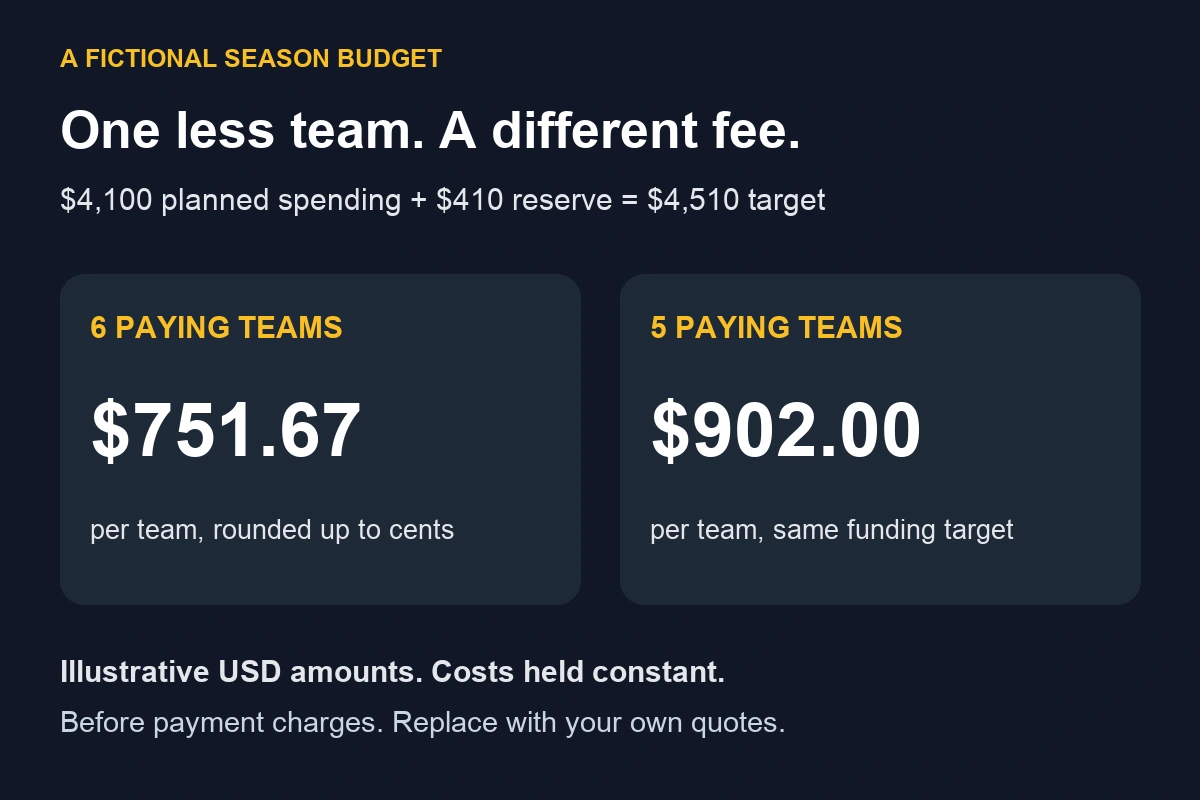
Original budget diagram: the same $4,510 funding target divided between six or five paying teams. Open the full-size comparison. The arithmetic is also written out below.
Start with games, not a fee that sounds nice
Our example has six teams playing a double round robin: each team plays the other five teams twice, for ten games per team. That is 6 × 10 ÷ 2 = 30 games across the league. The division by two matters because both teams are playing the same game. Your venue probably appreciates enthusiasm, but you do not need to book it twice.
Assume one booked slot per game, ten playing weeks with three games each, and no playoffs. For help building the matchups, use the round-robin scheduling guide. If you add playoffs, warmup time, or separate makeup bookings, add their costs before setting registration fees.
The worked season budget
The following assumptions are deliberately simple. The insurance/permit allowance is a placeholder to replace with confirmed requirements and quotes. The administration line is an illustrative allowance, not a subscription quote.
| Item and assumption | Amount |
|---|---|
| Venue: 30 slots × $80 | $2,400 |
| Officials: 30 games × $30 total per game | $900 |
| Shared equipment | $180 |
| Insurance and permits allowance | $420 |
| Administration and software allowance | $100 |
| Awards | $100 |
| Planned spending | $4,100 |
| Contingency: 10% of planned spending | $410 |
| Funding target before payment charges | $4,510 |
The 10% contingency is a choice for this example, not a guarantee that it covers your risks. Review cancellation terms, replacement equipment needs, and nonrefundable commitments when choosing your own buffer. For weather-related planning, see our rainout and rescheduling policy guide.
This example assumes no paid organizer compensation, uniforms, playoffs, or additional tax obligations. It does not mean those costs never apply. Add every applicable cost explicitly. Keep a refundable venue deposit in your cash-timing plan; do not automatically treat a returned deposit as a season expense.
Calculate the team fee and test lower enrollment
With six paying teams, the target is $4,510 ÷ 6 = $751.67 per team, rounded up to the nearest cent. Choosing a $755 team fee would collect $4,530 before payment charges: $20 above the target. It would not leave $430 of guaranteed profit; $410 of the target is still reserved for possible costs.
If only five teams register and you remain committed to the same spending and reserve, the required amount becomes $4,510 ÷ 5 = $902 per team. At the originally advertised $755, five teams bring in $3,775, leaving a $735 shortfall against the funding target.
That five-team comparison holds costs constant on purpose. If you can reduce bookings or other commitments, build a revised schedule and budget from the actual cancellation terms. Do not assume fewer teams automatically produce a proportional refund from the venue.
Decide your minimum enrollment, commitment deadline, and response to a shortfall before taking registrations. Options might include a smaller revised season, confirmed sponsorship, or not launching. Explain the applicable refund terms up front rather than surprising paid teams with a new invoice.
Understand what break-even does—and does not—tell you
The U.S. Small Business Administration's break-even guide calculates units needed as fixed costs divided by the amount each unit contributes after variable costs. For a league charging by team, the unit can be one paid team, provided your cost assumptions remain valid at that enrollment.
In this simplified example, before payment charges and with no per-team variable cost, $4,100 ÷ $755 is about 5.43 teams. You would need six whole paying teams to cover planned spending. Funding the additional reserve requires $4,510 ÷ $755, or about 5.97 teams—also six. A reserve target is a planning choice; it is not an expense already incurred.
If each additional team creates a separate cost, subtract that cost from the fee before dividing. Recalculate whenever the format changes enough to require more games, officials, or venue time.
Allow for payment charges without guessing a provider's rate
Use the current terms for the payment method and account you actually use. Distinguish league dues, software costs, and transaction charges so you do not count the same fee twice. A captain sending one payment and ten players paying individually can produce different totals when a fixed charge applies to each transaction.
For arithmetic practice only, suppose the league absorbs an invented processing charge of 3% plus $0.30 per successful team payment, with six payments and no other charges. To net the $4,510 target, the fee per team must be at least ($4,510 ÷ 6 + $0.30) ÷ 0.97 = about $775.23, rounded up to cents. Rounding the team fee to $776 gives $4,656 gross and $4,514.52 after those assumed charges.
Those percentages are not a quote for Beer League or any payment provider. Replace them, account for installment counts and any applicable refunds or other charges, and check the net amount before publishing your fee. The $755 example above does not cover this processing scenario.
Check when the money is needed
A season can balance on paper and still run short before the first game. Suppose the venue wants $1,200 upfront and the $420 coverage/permit allowance must also be paid before opening night. That is $1,620 needed early, even if the rest is due later. These amounts are already included in the spending plan, not extra costs.
Write down each due date alongside the amount. Compare it with money actually available after any settlement delays, restricted funds, or refund commitments. A screenshot saying “I'll pay Friday” is excellent evidence of optimism and less useful as a venue deposit.
Our league-fee collection guide covers communicating deadlines and tracking what is owed. This budget should tell you what those deadlines need to accomplish.
A worksheet you can copy
- Format: [teams] × [games per team] ÷ 2 = [total games]. Add separate playoff games if applicable.
- Costs: [venue] + [officials] + [equipment] + [coverage/permits] + [administration/software] + [other applicable costs] = [planned spending].
- Funding target: [planned spending] + [chosen reserve] − [confirmed funding available for these costs] = [amount needed from registrations].
- Fee: [registration target] ÷ [conservative paying-team count], then account for payment charges and per-team costs.
- Stress check: repeat with [one fewer team] and with [a plausible additional cost].
- Cash timing: [amount and date due] versus [available collected funds by that date].
- Closeout: compare actual collections and expenses; explain how any remaining reserve will be handled under your published policy.
Keep promised sponsorship separate from confirmed funds, and track the reserve separately from spending. When the season ends, a short explanation of where the money went is more useful than a mysterious “miscellaneous” line large enough to buy the commissioner a new grill.
Ready to organize the season? Create a Beer League account, keep this budget with your planning notes, and replace every hypothetical amount before collecting fees. The best budget is one you can explain to a captain in two minutes—and still afford when a team says, “Actually, we're out.”