A Rec League Rainout Policy Players Can Actually Follow
A useful rec-league rainout policy names the person who makes the call, tells players when and where to check, and explains how a postponed game gets a new date. Decide those things before the forecast turns suspicious. Your captain already has enough jobs without becoming an unpaid meteorologist in the group chat.
Use the policy and messages below as an organizer template. Adapt them to your venue's rules, your sport's competition rules, and your local emergency procedures. The example deadlines are communication choices, not permission to keep playing in unsafe conditions.
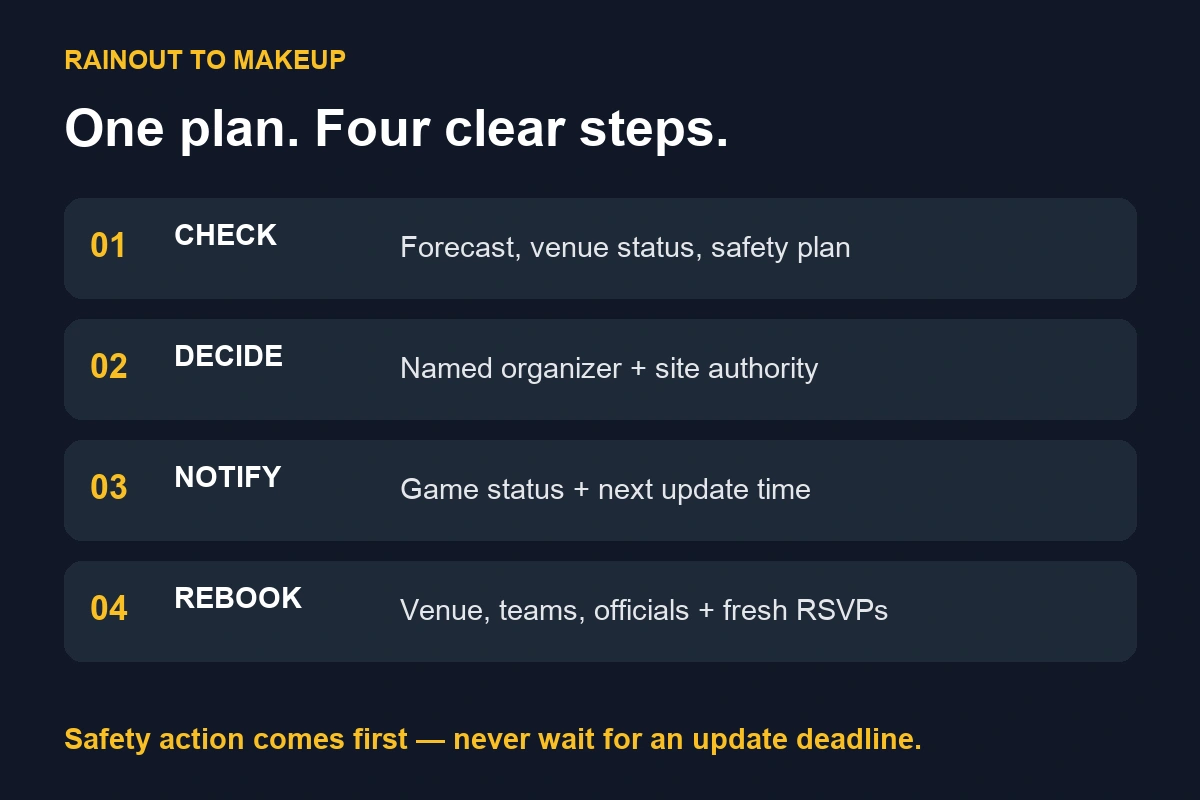
Original planning diagram: the four steps from a weather check to a confirmed makeup game. Open the full-size diagram.
Assign the decision before checking the radar
Put a named organizer and a backup in charge of the league's announcement. Record the venue contact, where official field closures appear, and who has authority to stop play at the site. A venue closure ends the debate about using that field; a captain's photo of one dry patch is not a reopening notice.
Separate the jobs of monitoring conditions, making the operational decision, and telling players. One person can handle several administrative tasks, but your safety plan needs someone who can actually watch the weather. The National Weather Service recommends a designated lightning monitor who is not also occupied as the coach, umpire, or referee. Its outdoor sports guidance also calls for a written plan covering when to stop, where to shelter, and when to resume.
Keep one authoritative game-status location. That might be your league's schedule or a clearly identified announcement page. Mirror the update into the channels players already use, and ask captains to acknowledge receipt. “I assumed somebody told the other team” is how you accidentally organize a solo warmup.
Use plain status labels
- Monitoring: the game is still scheduled, with another update due at a stated time. Conditions may change sooner.
- Delayed: the start or continuation is on hold. State the next check time without promising a restart.
- Postponed: the game will not take place at its original time. The makeup date is either confirmed or pending.
- Cancelled without a makeup: explain what your published rules say about the schedule, standings, and fees.
These are suggested communication labels, not a list of software status options. If your scheduling tool uses different terms, put the plain-language explanation in the announcement. Avoid “cancelled?” with a question mark; it is a surprisingly efficient way to create twelve different interpretations.
A worked timeline for a 7 p.m. game
This is a fictional example for an evening outdoor game with mostly local players. Move the planned update earlier when travel or venue arrangements require it. Immediate safety action always takes priority over these checkpoints.
- Day before, 6 p.m.: check the forecast and venue process. Confirm who is monitoring conditions, who can issue the announcement, and what shelter the safety plan identifies.
- Game day, noon: check official venue status and the forecast again. If uncertain, post a monitoring update with the next decision time.
- Game day, 4 p.m.: publish the planned travel update. If the venue has closed, announce the postponement. If information is still pending, say so explicitly and give the next update time; consider postponing rather than asking players to travel on an assumption.
- Before and during play: continue monitoring. An earlier “still scheduled” message is not an all-clear for the rest of the evening.
- By noon the next day: send either a confirmed makeup date or a progress update with the next promised update time.
For the season-level groundwork, our sports league schedule template helps keep dates, venues, and game details organized.
Keep lightning decisions out of the group vote
If thunder is heard, move immediately to safe shelter. The National Weather Service identifies a substantial building or an enclosed metal-topped vehicle with windows closed as appropriate shelter; dugouts and rain shelters are not safe lightning shelters. Stay sheltered for at least 30 minutes after the last thunder. More thunder starts that waiting period again. See the NWS lightning safety guidance.
Follow the event's safety plan and any stricter applicable requirements. Reaching the minimum waiting time does not override a closed field or other unsafe conditions. Identify shelter before players arrive, and account for the time needed to reach it. Nobody needs to win the argument about whether that rumble “really counted.”
Copy these three player messages
Replace every bracketed field, include the date and local time zone, and use the same wording across your announcements.
Weather monitoring
WEATHER UPDATE — [teams/game], [date], [time and time zone], [venue]. The game is currently scheduled. We are monitoring conditions and checking with the venue. Our next update will be posted by [time] at [status link]. Conditions may require an earlier change. Please check that update before leaving and follow any immediate safety instructions.
Postponement
GAME POSTPONED — [teams/game], originally [date and time], at [venue]. The game will not be played at that time because [brief reason]. Please do not travel to the venue for this game. The makeup date is [pending / confirmed date, time, and venue]. Our next update is due [date and time] at [status link]. Captains: please confirm your players have received this. Fee or credit information: [published policy link].
Confirmed makeup
MAKEUP CONFIRMED — [teams/game] has moved from [original date and time] to [new date, time, and time zone] at [venue and field/court]. Please check the updated game details at [link] and confirm your availability again by [deadline]. Captains: flag roster or schedule conflicts to [contact] by [deadline]. [State any confirmed fee/credit information, or link to the policy.]
For channel choices and response expectations, see our team communication guide. The important part is a consistent update, not a dramatic weather graphic posted in four places with four different times.
Reschedule the game, not just the calendar entry
Before announcing a replacement date, confirm the venue booking, officials if needed, both teams' availability, and any shared-player conflicts. Use a reserved makeup slot when possible. Offer a small number of realistic alternatives with a response deadline rather than opening an unlimited poll for everyone who has ever owned cleats.
Keep a record of the original fixture and why it changed. If play had already started, apply the competition's published rule for a suspended, completed, or replayed game; do not quietly turn an interrupted game into a forfeit. Resolve score and standings treatment before publishing the replacement details.
Then ask for fresh availability. A yes for Tuesday is not automatically a yes for Thursday. Explain guest, substitute, and roster eligibility under your existing rules; the substitute-management guide can help with that conversation.
Your rainout policy, in six lines
- Decision owner: [name/contact], with [backup]. Venue closure source: [link/contact].
- Safety plan: [plan link], weather monitor [name], shelter [location], and site authority [role].
- Updates: planned travel update by [time]; urgent changes posted immediately at [status location].
- Makeups: [reserved slots or selection process], with the next update promised within [time period].
- Competition treatment: interrupted games, unplayed games, and standings follow [rule link].
- Money: refunds, credits, and any makeup charges follow [published terms]; contact [person] for an unresolved case.
Set fee expectations before registration and check them against your venue arrangements. Do not promise a credit until you know what your league's terms provide. Tell players when a financial question is still being resolved instead of treating silence as a policy.
Preparing your next season? Create a Beer League account to get started. Keep this policy with your league information, fill in the blanks, and give players a reliable place to check. You cannot book better weather, but you can spare everyone the drive to a locked gate.