How to Schedule a Round Robin League: Complete Examples
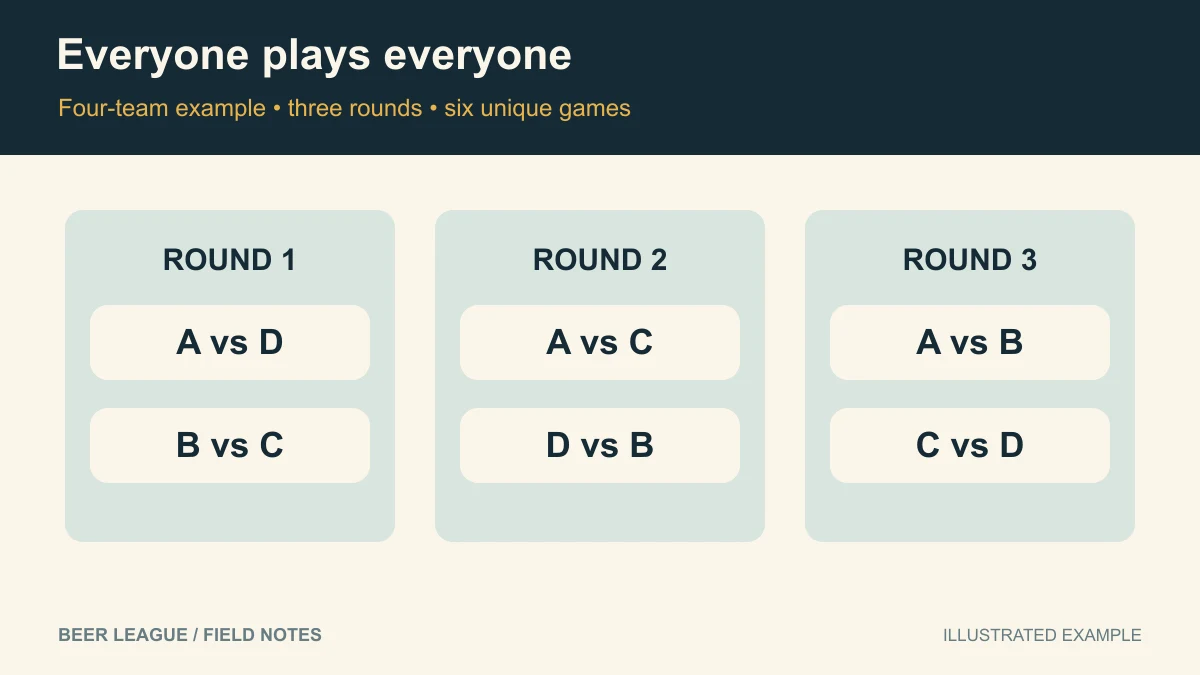
Hero diagram: A complete four-team round robin has three rounds and six unique pairings. View full-size image.
A single round robin gives every team one game against every other team. Build the matchups first, place them into confirmed venue slots, then check each team's dates and start times before you publish. Below are complete six-team and five-team examples you can copy.
Updated September 18, 2026. This guide now includes the material from our scheduling-tips and manual-scheduling articles.
Check that the season fits your venue
For n teams, a single round robin contains n × (n − 1) ÷ 2 games. Each team plays n − 1 games. Double those totals for a double round robin. A game slot means one playing surface for one full game, including any required turnaround time.
- Four teams: 6 games across 3 rounds.
- Six teams: 15 games across 5 rounds.
- Eight teams: 28 games across 7 rounds.
Six teams on one court with three usable slots each Tuesday can finish one round per week in five playing weeks. With only two slots each Tuesday, you need at least eight dates for 15 games, and some teams will sit out on some dates. A round is a set of matchups, not necessarily a calendar week.
Before committing, list venue hours, closures, holidays, game duration, turnover time, officials, and team availability. Reserve makeup capacity if cancellations are plausible. Decide whether playoffs use additional dates; do not quietly take those slots from the regular season.
A complete six-team round-robin schedule
Replace A–F with your team names. Each team appears once per round, plays five games, and faces each opponent once. The order below does not assign home advantage.
| Round | Game 1 | Game 2 | Game 3 |
|---|---|---|---|
| 1 | A–F | B–E | C–D |
| 2 | A–E | F–D | B–C |
| 3 | A–D | E–C | F–B |
| 4 | A–C | D–B | E–F |
| 5 | A–B | C–F | D–E |
These pairings use the circle method: hold A fixed, rotate the remaining teams one position each round, and pair the opposite positions. For a double round robin, repeat the five rounds after the first cycle and reverse home/away assignments where those matter.
Five teams: one bye each round
Add a sixth placeholder called BYE, use the same rotation, and give the team paired with BYE the round off. Do not record the bye as a win or a played game.
| Round | Game 1 | Game 2 | Bye |
|---|---|---|---|
| 1 | B–E | C–D | A |
| 2 | A–E | B–C | D |
| 3 | A–D | E–C | B |
| 4 | A–C | D–B | E |
| 5 | A–B | D–E | C |
Turn matchups into a fair calendar
- Assign real dates and locations. Record the venue and court or field, not just a building name. Show the timezone.
- Rotate early and late starts. Do not always put Game 1 in the first slot: A appears in that column every round. Count early and late starts for every team and move games within each round to spread them as evenly as your constraints allow.
- Separate home/away from pairing order. In a five-game season, a 3–2 split is the closest possible balance. Check venue restrictions before assigning it.
- Check recovery and travel. Avoid overlapping games, unrealistic travel between sites, and unannounced doubleheaders. Allow enough time for warmups and surface changes.
- Review by team. Read one team's whole season at a time. Problems are easier to spot than when reading the calendar date by date.
Use the copyable season schedule template to record these details. The template is the calendar; the tables above supply the matchups.
Before you send it to players
- The total game count matches the format.
- Every required opponent pairing appears the correct number of times.
- No team or venue is booked twice at the same time.
- Byes, early starts, late starts, and home/away assignments have been counted.
- Makeup dates, cancellations, and playoff dates are clearly identified.
- Captains have a review deadline and one place to report a conflict.
Ask captains to check availability before publication, but distinguish a genuine constraint from a preference. Keep a change log after publication: original date, replacement date, reason, and whom you notified. Send updates to the affected teams and officials, and update the shared schedule immediately.
Choose your playoff format and tiebreakers before the first game. For ongoing responsibilities, use our commissioner checklist.
Ready to put the schedule where players can find it? Create a Beer League account and review current plan features before choosing scheduling tools for your season.