How to Handle Subs in a Rec League (Without Ruining the Season)
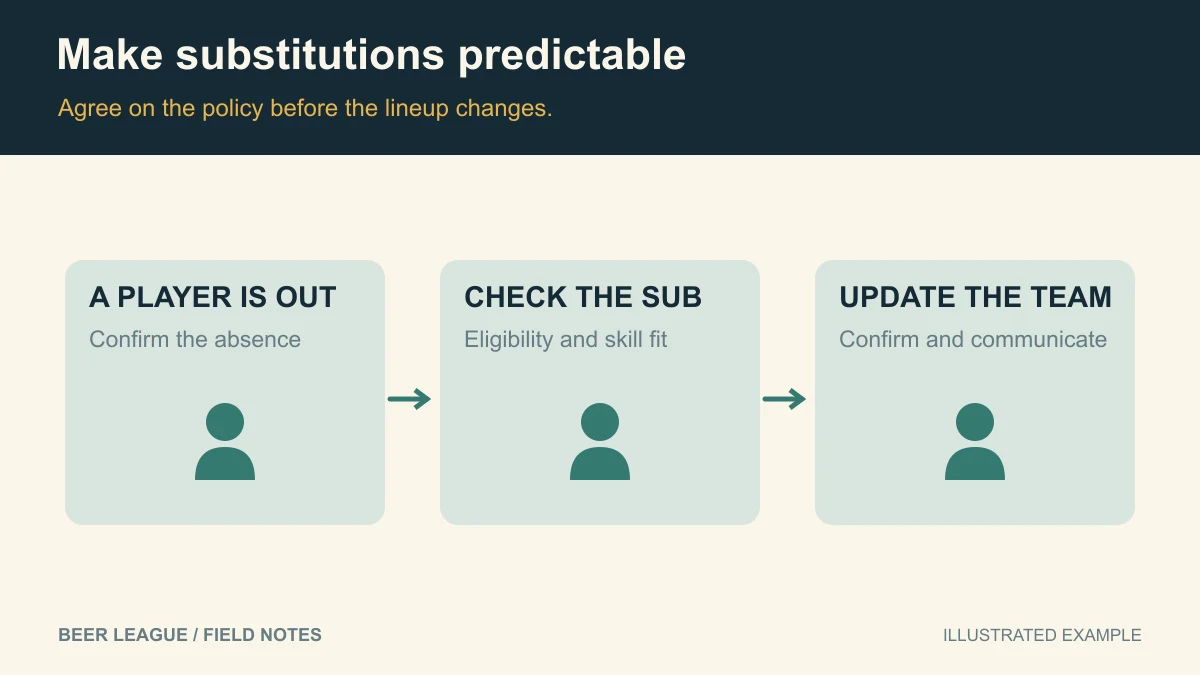
Hero diagram: Confirm an absence, check the substitute, and update the team. View full-size image.
Every rec league commissioner knows the feeling. It's game night, you're short two players, and someone's cousin's roommate shows up claiming he "used to play in college." Twenty minutes later, he's dropped three people and your league chat is on fire.
Substitute players are a necessary evil in recreational leagues. People travel, get injured, have kids — life happens. But without a clear sub policy, subs become the single biggest source of drama in any league. Here's how to handle them the right way.
Why You Need a Sub Policy (Yesterday)
If you don't have a written sub policy, you're basically inviting chaos. Every week becomes a negotiation. "Can my buddy play?" turns into "Why did THAT guy get to sub but mine can't?" And suddenly you're a lawyer instead of a league organizer.
A clear, written policy eliminates 90% of sub-related arguments. It doesn't have to be complicated — it just has to exist, be communicated, and be enforced consistently.
The Core Rules Every Sub Policy Needs
1. Define Who Can Sub
This is the big one. Options range from wide open to locked down:
- Open subs: Anyone can fill in. Works for casual, low-stakes leagues.
- Approved list: Maintain a pre-approved sub list that players can pull from. Best balance of flexibility and control.
- League players only: Subs must already be rostered on another team in the league. Keeps skill levels consistent.
- No subs: You play with who you've got. Only works for sports where short-handed play is viable (like hockey).
For most rec leagues, the approved list approach hits the sweet spot. Players know who's available, you've already vetted skill levels, and there's no scrambling at game time.
2. Set a Skill Level Standard
This is where most leagues screw up. A D-league team brings in a ringer who played college ball, and suddenly the other team is getting demolished. That's not fun for anyone — except maybe the ringer.
Your policy should state that subs must match the division's skill level. If you're running a beginner division, the sub should be a beginner. This is subjective, sure, but having it written down gives you grounds to say no when someone tries to sneak in a semi-pro.
3. Limit Sub Appearances
A sub who plays every week isn't a sub — they're a roster player who isn't paying dues. Set a cap:
- Per player: A sub can play a maximum of X games per season (3-5 is common).
- Per team per game: No more than 2-3 subs per team per game. Otherwise it's not really your team playing.
- Playoff restriction: Many leagues require that subs can't play in playoff games, or must have played at least X regular season games to be eligible.
These limits keep things fair and prevent teams from strategically loading up for key games.
4. Require Advance Notice
"Hey, I brought someone" five minutes before game time puts the commissioner in an awkward spot. Require at least 24 hours notice, or whatever timeline works for your league. This gives the opposing team a heads-up and gives you time to vet the sub if needed.
Some leagues require the sub's name be submitted in advance. Others just need a heads-up that a sub is coming. Either way, no surprises at game time.
5. Handle Payment
Does the sub pay? Most leagues charge subs a per-game fee — typically $5-15 depending on the sport and venue costs. This covers their share of ice/field time and discourages teams from just rotating free players through all season.
If you're using BeerLeagues to manage your league, you can handle sub payments right through the app with per-game fees and Stripe integration. No more collecting cash at the rink or chasing people down on Venmo.
Common Sub Scenarios (And How to Handle Them)
The Ringer
Someone brings a sub who's clearly two skill levels above your division. The right move: pull them aside before the game and explain the skill level policy. If they've already started playing and it's obviously a mismatch, address it at halftime. It's uncomfortable, but it's your job.
The Permanent Sub
A player who subs for the same team every single week. At that point, add them to the roster or cut them off. They're either committed to the team or they're not. Either way, they should be paying full season fees.
The No-Show's Replacement
One player consistently doesn't show up and the team always brings a sub. The problem isn't the sub — it's the no-show. Address the attendance issue directly with the player. If they can't commit, open the roster spot for someone who will.
The Playoff Ringer
Teams suddenly finding amazing subs right before playoffs. This is why you need a playoff eligibility rule. Common approach: a player must have played in at least 3-5 regular season games to be eligible for playoffs. No exceptions.
How to Communicate Your Sub Policy
Having a policy is useless if nobody knows about it. Here's what works:
- Include it in your league rules document that every captain signs at season start.
- Post it in your league communication channel (group chat, app, email).
- Remind captains at the midseason point and before playoffs.
- Enforce it consistently. The moment you make exceptions, the policy is dead.
Make Sub Management Easy on Yourself
Tracking who subbed when, how many times, and whether they've hit their limit — that's a lot of bookkeeping on top of everything else you're managing. This is exactly the kind of thing that's better handled by software than spreadsheets.
BeerLeagues lets you manage rosters, track attendance, and handle payments all in one place. When a sub shows up, you can add them as a guest player for the game, and the app keeps track of everything automatically. No more flipping through text messages trying to figure out if this is Dave's third or fourth time subbing this season.
The Bottom Line
Subs keep your league running when life gets in the way. But without guardrails, they create more problems than they solve. Write a simple, clear policy. Communicate it early. Enforce it fairly. And use tools that make tracking easy so you can spend your energy on actually enjoying the league you built.
Your players will thank you. Well, most of them. The guy who wanted to bring his ex-pro buddy might not. But everyone else will.