How to Track Stats in Your Rec League (Without Making It a Full-Time Job)
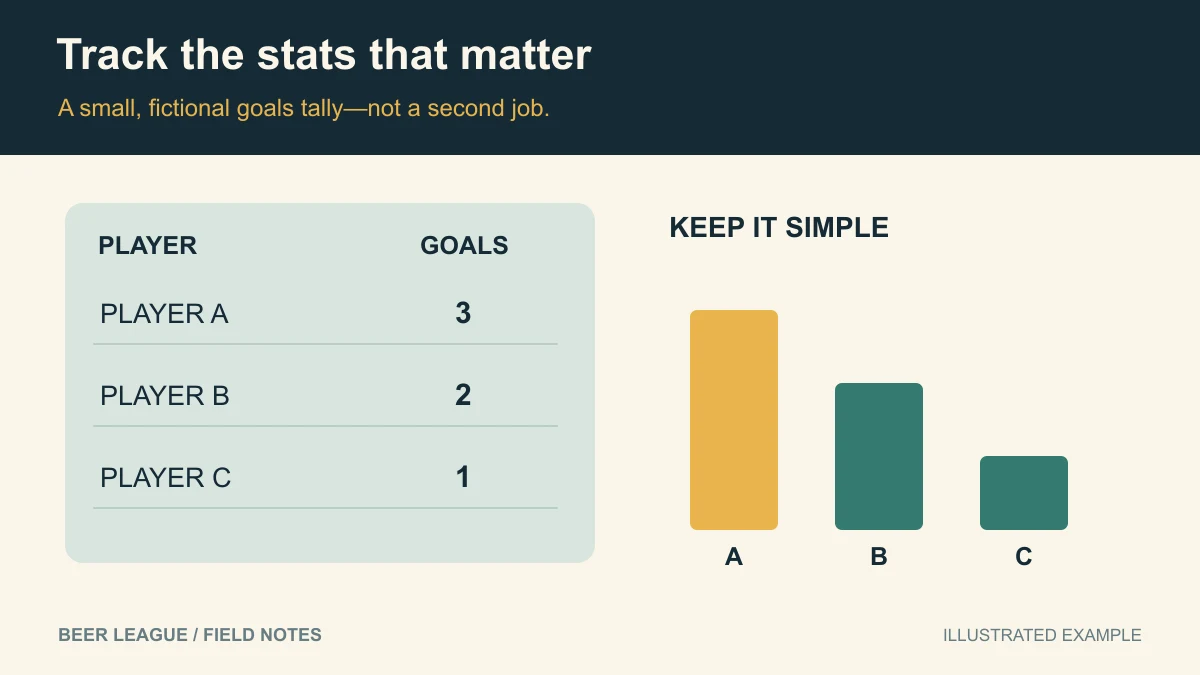
Hero diagram: A fictional goals tally shows players A, B and C with 3, 2 and 1 goals. View full-size image.
You started a rec league because you love the game. Now you're hunched over a notebook after every Tuesday night, trying to remember if Jake had two goals or three and whether that assist in the second half actually counted. Sound familiar?
Tracking stats in a rec league doesn't have to suck. But doing it wrong—or not doing it at all—means you're missing out on one of the things that keeps players coming back season after season. Here's how to do it right without losing your mind.
Why Bother Tracking Stats at All?
Let's get this out of the way first. Some commissioners think stats are overkill for a rec league. "We're not the NHL," they say. And yeah, you're not. But here's what stats actually do for your league:
- They keep players engaged. People care about their numbers. Even the guy who says he doesn't care absolutely checks the leaderboard.
- They settle arguments. "I'm the top scorer" hits different when there's a spreadsheet backing it up—or proving you wrong.
- They make your league feel legit. Standings, player stats, season leaders—it's the difference between a pickup game and an actual league.
- They help with team balancing. Next season's draft is a lot easier when you know who actually performed and who just talked a big game.
Bottom line: stats make your league stickier. Players who see their name on a leaderboard are way more likely to come back next season.
What Stats Should You Track?
This depends on your sport, but the golden rule is: track what you can track consistently. If you can't do it every single game, don't bother. Inconsistent stats are worse than no stats.
Hockey / Soccer / Floor Hockey
- Goals
- Assists
- Points (goals + assists)
- Penalty minutes (if your league tracks them)
- Goalie saves and goals against (if you're ambitious)
Basketball
- Points
- Rebounds
- Assists
- Steals (optional but fun)
Softball / Baseball
- Hits
- Runs
- RBIs
- Home runs
- Batting average
Volleyball / Kickball / Flag Football
- Wins and losses per player (if you shuffle teams)
- Individual stats vary—keep it simple. Touchdowns for flag football, kills for volleyball.
Start with 2-3 key stats per sport. You can always add more later. Nobody ever quit a league because you only tracked goals and assists instead of plus-minus.
The Three Ways to Track Stats (Ranked)
1. Paper Scoresheets (The Old School Way)
Grab a clipboard, print some templates, hand them to someone on the bench. This works if you have exactly one game per week and a very dedicated scorekeeper.
Pros: Free, no tech needed, feels authentic.
Cons: Someone has to manually enter everything later. Sheets get lost, beer gets spilled on them (it's a beer league, let's be real), and handwriting is occasionally illegible. Also, your players can't check stats on their phone at the bar after the game.
2. Spreadsheets (The "I'll Just Use Google Sheets" Way)
A shared Google Sheet is a massive upgrade over paper. You can update it in real-time from your phone, everyone can view it, and the math does itself.
Pros: Free, shareable, formulas handle averages and totals.
Cons: Gets unwieldy fast. By mid-season you've got 47 tabs, three broken formulas, and a pivot table that somehow references last season's data. Plus it looks like a spreadsheet, because it is one. Not exactly the experience that makes people say "wow, this league is well run."
3. A League Management App (The "Why Didn't I Do This Sooner" Way)
This is where tools like BeerLeagues come in. Instead of cobbling together spreadsheets and group chats, you get standings, stats, schedules, and player profiles all in one place. Players can check their own stats from the app. You enter scores after each game and the rest is automatic.
Pros: Professional-looking, automatic calculations, players can self-serve, works on any phone.
Cons: Some apps cost money, but BeerLeagues has a free tier that handles most of what a rec league needs.
Tips for Actually Keeping Up With It
The biggest problem with rec league stats isn't choosing what to track—it's keeping up with it game after game. Here's what works:
Designate a Scorekeeper (Not You)
If you're the commissioner AND the scorekeeper AND playing in the game, something's going to slip. Rotate the duty. The team that's sitting out keeps score. Or recruit someone's partner who comes to watch anyway.
Enter Stats the Same Night
Do it in the parking lot. Do it at the bar. Do it before you go to bed. The longer you wait, the fuzzier the details get and the less likely it actually happens. "I'll do it tomorrow" is how you end up three weeks behind with a notebook full of chicken scratch.
Keep It Simple at First
Track goals and assists. That's it. Once you've proven you can do that consistently for a full season, add more. Nobody's going to complain that you didn't track blocked shots in a Tuesday night floor hockey league.
Make Stats Visible
If you track stats but nobody sees them, what's the point? Post leaders in the group chat after each week. Share the link to your standings page. With BeerLeagues, every player can open the app and see exactly where they stand—which is half the fun.
The Secret Benefit: Better Seasons
Here's something most commissioners don't think about: stats from this season make next season better. When you're balancing teams for a new season or running a draft, having actual performance data is gold. Instead of guessing who's good based on vibes, you've got numbers.
It also helps you spot problems. If one team is winning every game 10-1, the stats will show the talent gap before half your league stops showing up. You can make mid-season adjustments—move a player, adjust the schedule—before it's too late.
Just Start
The best stat tracking system is the one you'll actually use. If that's a Google Sheet, cool. If that's a napkin at the bar, well, it's better than nothing (barely).
But if you want something that looks professional, updates automatically, and gives your players a reason to check in between games, give BeerLeagues a shot. It's free to start, it takes about five minutes to set up, and your players will think you suddenly got your act together. Which, honestly, you did.