How to Balance Teams in a Rec League (So Nobody Rage-Quits by Week 3)
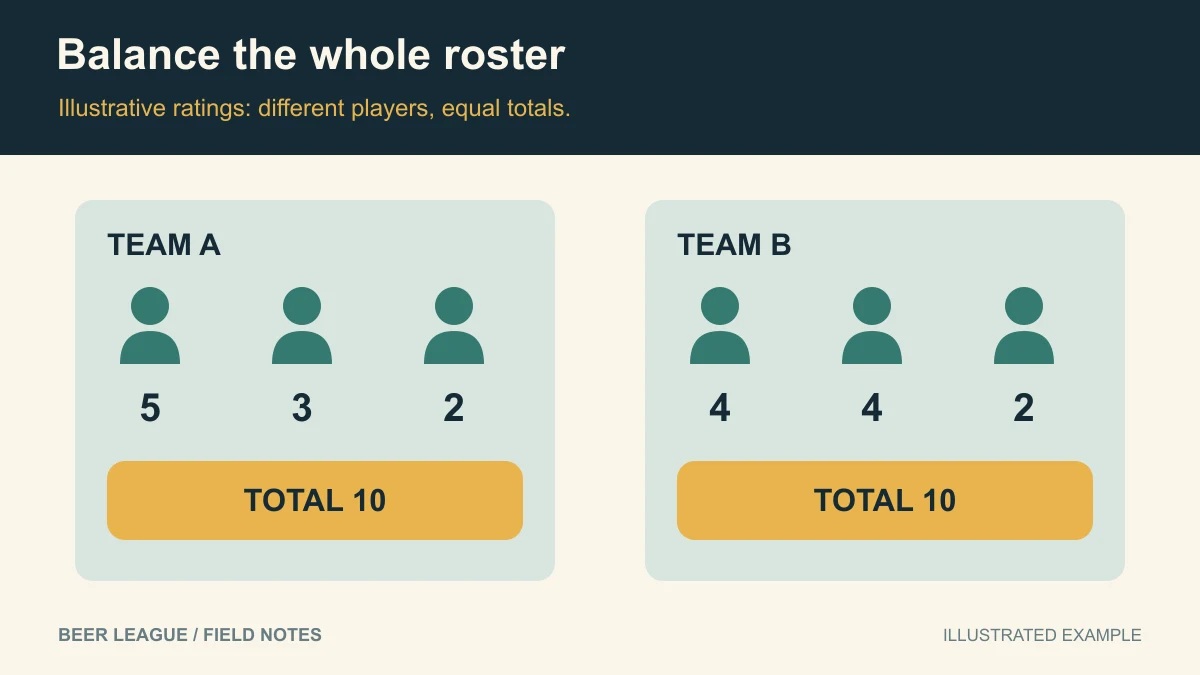
Hero diagram: Two fictional teams have equal rating totals: 5+3+2 and 4+4+2. View full-size image.
Every rec league commissioner has lived this nightmare: one team is 8-0, another is 0-8, and half your league is threatening to bail because it's just not fun anymore. Blowouts kill leagues. Full stop. Nobody signs up to get destroyed every week, and nobody wants to win by 30 every game either (okay, some people do, but they're the worst).
Balancing teams is the single most important thing you can do to keep your league healthy, competitive, and actually enjoyable. Here's how to do it without losing your mind.
Why Team Balance Matters More Than You Think
An unbalanced league doesn't just produce boring games — it creates a death spiral. The bad teams lose players first. Then you're scrambling for subs. Then games get cancelled. Then the good teams get annoyed because they showed up for nothing. Before you know it, your 8-team league is down to 5 and the season's only half over.
Balanced teams mean closer games, which means more fun, which means players come back next season and tell their friends. It's literally the foundation of a league that lasts.
Step 1: Know Your Players
You can't balance teams if you don't know what you're working with. Before you assign anyone to a roster, you need some way to evaluate skill levels. Here are a few approaches:
- Self-ratings: Ask players to rate themselves 1-5 during registration. It's not perfect — some people sandbagging, some people wildly overestimating their abilities — but it's a starting point.
- Commissioner ratings: If you've been running the league for a while, you probably have a decent sense of who's good, who's average, and who's there for the beer. Your subjective ratings are often more accurate than self-assessments.
- Past stats: If you tracked stats last season, use them. Points, assists, goals, whatever your sport measures. Data doesn't lie (unless someone was stat-padding against the worst team).
- Combine or tryout: For larger or more competitive leagues, a pre-season skills session lets you see everyone in action before making teams. It's extra work, but it's the gold standard.
Step 2: Use a Rating System
Once you have evaluations, assign every player a number. Keep it simple — a 1-5 or 1-10 scale works fine. Then when you're building rosters, you're aiming for each team to have roughly the same total rating.
Example with a 1-5 scale across a 10-player roster:
- Team A: 5, 4, 3, 3, 2, 2, 2, 1, 1, 1 = 24
- Team B: 4, 4, 3, 3, 3, 2, 2, 1, 1, 1 = 24
- Team C: 5, 3, 3, 3, 2, 2, 2, 2, 1, 1 = 24
You're not going to get them perfectly even every time, but getting within a point or two across all teams goes a long way. Pay attention to position balance too — a hockey team with four elite forwards and no defense is going to have a weird season.
Step 3: The Draft Approach
Instead of the commissioner assigning everyone, let captains draft. A snake draft (1-2-3-4-4-3-2-1) naturally creates more balanced teams than a straight draft. The last pick in round one gets the first pick in round two, which smooths things out.
Draft nights are also just fun. They build community, create rivalries before the season even starts, and give people a reason to show up to the bar on a Tuesday. Win-win-win.
Pro tip: seed captains so you don't have the four best players all picking first. Pair a strong captain with a later draft position and vice versa.
Step 4: Consider Position and Role Balance
Total skill rating isn't the whole picture. You need to think about:
- Goalies/keepers: In hockey or soccer, goalie quality can swing games more than anything. Distribute your goalies as evenly as possible.
- Positional depth: Every team needs defenders, midfielders, forwards (or whatever your sport calls them). Don't let one team hoard all the players who can actually play defense.
- Experience mix: A team of all first-timers is going to struggle regardless of individual ability. Mix veterans and newcomers on every roster.
- Friend groups: This is a hot take, but don't let entire friend groups stack onto one team. It creates chemistry advantages that ratings can't capture. Spread them out a little — they'll survive.
Step 5: Mid-Season Adjustments
Sometimes you do everything right and it's still lopsided. That's okay. Good commissioners adapt. Here's what you can do:
- Trade window: Open a short trade period at the midpoint. Let captains negotiate swaps to address imbalances.
- New player distribution: When someone new joins mid-season, add them to the weakest team. Don't just put them wherever there's a roster spot.
- Schedule tweaks: Give weaker teams an extra game against other weaker teams. Not ideal, but it keeps things interesting.
- Handicap scoring: In casual leagues, a point spread or modified scoring can level the playing field without changing rosters.
Step 6: Use Technology (Seriously)
If you're still doing all this with a notebook and a prayer, you're making it way harder than it needs to be. League management tools can track player ratings, automate draft orders, balance teams by total skill rating, and let you make adjustments on the fly.
BeerLeagues has built-in tools for exactly this — including auto-draft for pickup games that splits players into balanced teams based on roles and skill. No more eyeballing it at the rink hoping it works out. The app handles the math so you can focus on actually running the league.
The Bottom Line
Balanced teams aren't about making every game end in a tie. They're about making every game feel competitive. Close games are exciting. Exciting games bring people back. People coming back means your league survives, grows, and becomes the thing everyone looks forward to every week.
Do the work up front, use actual data instead of guessing, and don't be afraid to make adjustments when something isn't working. Your league will be better for it.
Ready to stop guessing and start managing your league the right way? Check out BeerLeagues — it's free to get started and handles the stuff that used to make you want to quit.